Description
- Numéro de photo: 42N-267-20
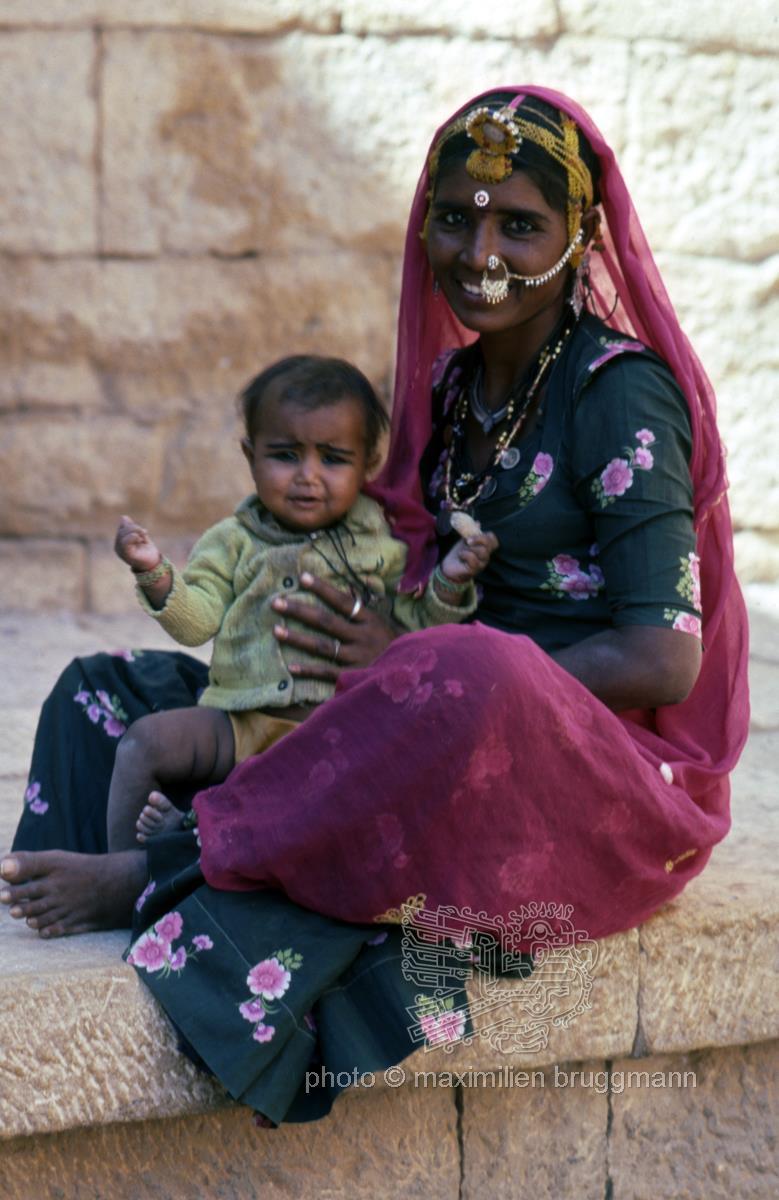
Barbati, a nomad dressed in the traditional attire of the Bhopa community from the desert region around Jaisalmer in Rajasthan, sits on a stone step with her toddler on her lap. She wears a traditional ensemble consisting of a vividly coloured veil (known as an odhni or dupatta) and a printed blouse (choli), as well as a floor-length, loose-fitting skirt (ghagra). A striking feature is the large, golden nose ring, which is artfully fastened to her hair or ear by a chain. In many rural regions of Rajasthan, this piece of jewellery signifies a woman’s marital status. On her forehead, a round, glittering pendant sits directly at the hairline, a typical element of Rajasthani wedding and festive attire. On her wrists she wears thick, traditional bangles (often made of imitation ivory, bone or colourful plastic), which can cover almost the entire forearm and are firmly rooted in the regional culture. – 1990
Description
- Numéro de photo: 42N-267-20
Barbati, a nomad dressed in the traditional attire of the Bhopa community from the desert region around Jaisalmer in Rajasthan, sits on a stone step with her toddler on her lap. She wears a traditional ensemble consisting of a vividly coloured veil (known as an odhni or dupatta) and a printed blouse (choli), as well as a floor-length, loose-fitting skirt (ghagra). A striking feature is the large, golden nose ring, which is artfully fastened to her hair or ear by a chain. In many rural regions of Rajasthan, this piece of jewellery signifies a woman’s marital status. On her forehead, a round, glittering pendant sits directly at the hairline, a typical element of Rajasthani wedding and festive attire. On her wrists she wears thick, traditional bangles (often made of imitation ivory, bone or colourful plastic), which can cover almost the entire forearm and are firmly rooted in the regional culture. – 1990