logo
  • Home
  • His life ...
    • Biography
    • Curriculum Vitae
    • Book: “Maximilien au Désert” NEW !
  • His work ...
    • Books
    • Expos
    • Painting
    • Embossings
    • New Year's wishesNEW !
    • Online ExhibitionsNEW !
    • Slideshows
  • Media ...
    • Documentation
    • Videos
    • Contact
  • Photo Gallery ...
    • All Photos
    • -
    • Sahara Rock Art completed
    • Tuareg
    • Pueblos
    • Northwest Indians
    • Peru
    • The culture of the Incas
    • Pre-Inca cultures
    • The Northern Andes Expanded!
    • The Central Andes Expanded!
    • The Southern Andes Expanded!
    • Argentina
    • Gauchos
    • Central America
    • Sahara 1962-1975
    • Sahel
    • Sahara : Tassili - Tadrart 1993
    • From the Ténéré to the Aïr Mountains
    • In the dunes of Erg Izane
    • Across the Tamgak Mountains
    • From Adrar Bous into the Tamgak Mountains
    • With the Tuareg on the edge of the Tamgak Mountains
    • Building a Tataram: Documentation
    • The Spice Route – Spices NEW !
    • The Spice Route – Java and Sulawesi NEW !
    • The Spice Route – Moluccas NEW !
    • The Spice Route – Malaysia, Singapore and Sri Lanka NEW !
    • The Spice Route – India : Kerala, Goa and Mumbai NEW !
    • The Spice Route – India: Rajasthan NEW !
    • The Spice Route – Africa – Europe NEW !
  • Comments
    flag flag flag flag    

Description

  • Foto Number: AND-176

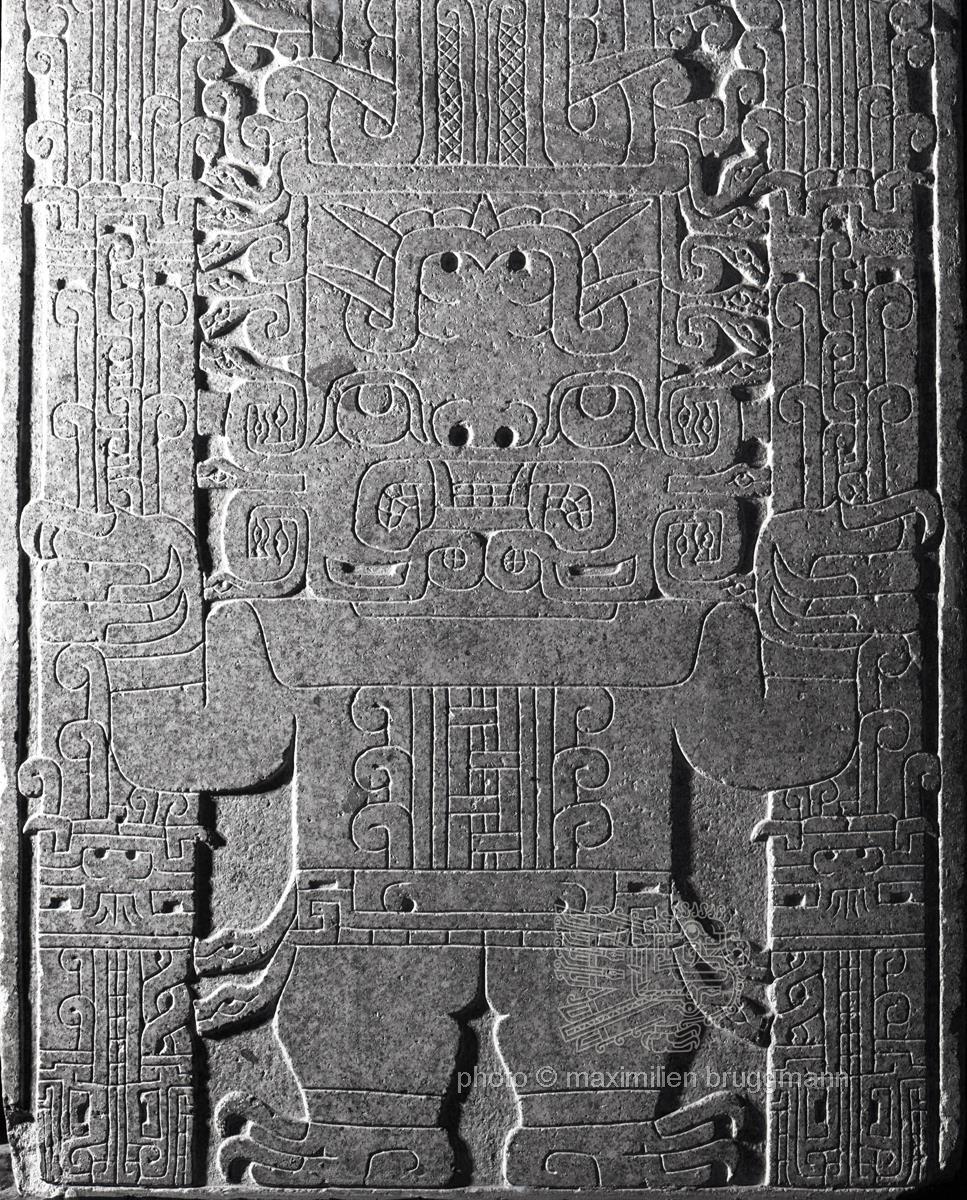
Chavín culture, Peru – Detail of the lower part of the Raimondi stele. Considered a masterpiece of this culture, the stele is 74 centimetres wide, 195 centimetres high and 17 centimetres thick. First described by A. Raimondi at the end of the 19th century, the stele served as a table for a farmer for many years; fortunately, it was turned upside down, meaning that the engravings are exceptionally well preserved and were also spared by the landslides that repeatedly buried the Chavín site. The figure in this detail is sometimes interpreted as a human with big cat attributes, and at other times as a feathered cat god. When turned upside down, a second face appears, formed from the mouth and chin of the upright figure. Museo Nacional de Antropología y Arqueología, Lima, Peru. - 1976
  • Keywords:
    South America Peru Chavín Andes Central Andes culture-Chavín Estela Raimondi monolith

Description

  • Foto Number: AND-176

Chavín culture, Peru – Detail of the lower part of the Raimondi stele. Considered a masterpiece of this culture, the stele is 74 centimetres wide, 195 centimetres high and 17 centimetres thick. First described by A. Raimondi at the end of the 19th century, the stele served as a table for a farmer for many years; fortunately, it was turned upside down, meaning that the engravings are exceptionally well preserved and were also spared by the landslides that repeatedly buried the Chavín site. The figure in this detail is sometimes interpreted as a human with big cat attributes, and at other times as a feathered cat god. When turned upside down, a second face appears, formed from the mouth and chin of the upright figure. Museo Nacional de Antropología y Arqueología, Lima, Peru. - 1976

  • Keywords:
    South America Peru Chavín Andes Central Andes culture-Chavín Estela Raimondi monolith

Website © 2026 pb + StratLabs
Copyright © Estate of Maximilien Bruggmann for all photos. Any use for commercial purposes prohibited.
flag flag flag flag