logo
  • Home
  • His life ...
    • Biography
    • Curriculum Vitae
    • Book: “Maximilien au Désert” NEW !
  • His work ...
    • Books
    • Expos
    • Painting
    • Embossings
    • New Year's wishesNEW !
    • Online ExhibitionsNEW !
    • Slideshows
  • Media ...
    • Documentation
    • Videos
    • Contact
  • Photo Gallery ...
    • All Photos
    • -
    • Sahara Rock Art completed
    • Tuareg
    • Pueblos
    • Northwest Indians
    • Peru
    • The culture of the Incas
    • Pre-Inca cultures
    • The Northern Andes Expanded!
    • The Central Andes Expanded!
    • The Southern Andes Expanded!
    • Argentina
    • Gauchos
    • Central America
    • Sahara 1962-1975
    • Sahel
    • Sahara : Tassili - Tadrart 1993
    • From the Ténéré to the Aïr Mountains
    • In the dunes of Erg Izane
    • Across the Tamgak Mountains
    • From Adrar Bous into the Tamgak Mountains
    • With the Tuareg on the edge of the Tamgak Mountains
    • Building a Tataram: Documentation
    • The Spice Route – Spices NEW !
    • The Spice Route – Java and Sulawesi NEW !
    • The Spice Route – Moluccas NEW !
    • The Spice Route – Malaysia, Singapore and Sri Lanka NEW !
    • The Spice Route – India : Kerala, Goa and Mumbai NEW !
    • The Spice Route – India: Rajasthan NEW !
    • The Spice Route – Africa – Europe NEW !
  • Comments
    flag flag flag flag    

Description

  • Foto Number: AND-353

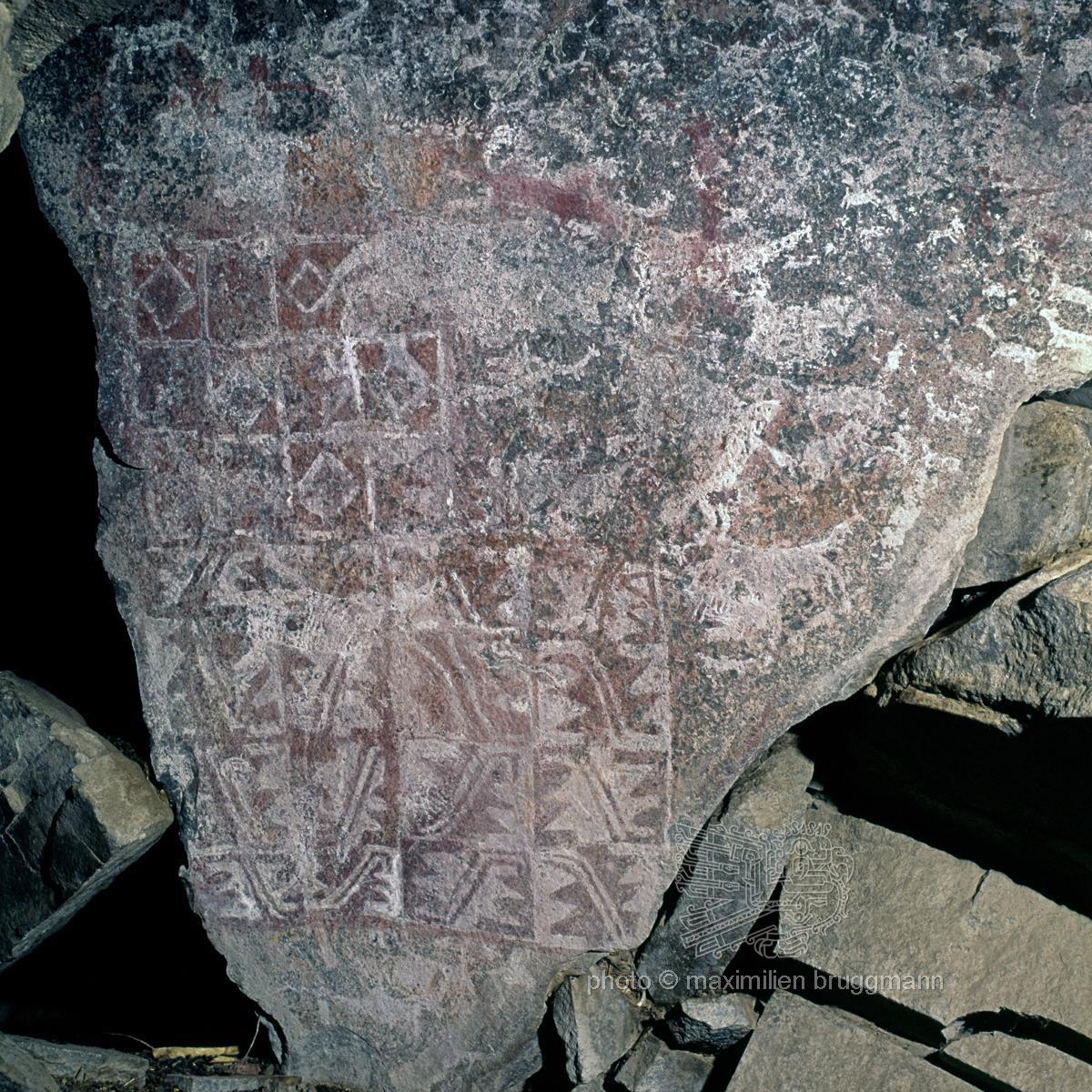
The archaeological site of Qelqatani (often also spelled Kalkatani or Quelcatani) is situated in the province of Chucuito in the department of Puno, not far from Mazo Cruz, at an altitude of over 4,000 metres. In contrast to the region’s better-known, purely figurative depictions of animals and hunting scenes (such as the typical guanaco and llama scenes), this particular panel features a dense, lattice-like arrangement of geometric diamonds, zigzag bands and abstract patterns. It is attributed to a later transitional phase (the Formative period), during which people became more settled and began to domesticate alpacas and llamas. – Peru – 1976
  • Keywords:
    South America Peru Puno Central Andes rock painting Pre-Inca Kelkatani Archaeology Prehistoric

Description

  • Foto Number: AND-353

The archaeological site of Qelqatani (often also spelled Kalkatani or Quelcatani) is situated in the province of Chucuito in the department of Puno, not far from Mazo Cruz, at an altitude of over 4,000 metres. In contrast to the region’s better-known, purely figurative depictions of animals and hunting scenes (such as the typical guanaco and llama scenes), this particular panel features a dense, lattice-like arrangement of geometric diamonds, zigzag bands and abstract patterns. It is attributed to a later transitional phase (the Formative period), during which people became more settled and began to domesticate alpacas and llamas. – Peru – 1976

  • Keywords:
    South America Peru Puno Central Andes rock painting Pre-Inca Kelkatani Archaeology Prehistoric

Website © 2026 pb + StratLabs
Copyright © Estate of Maximilien Bruggmann for all photos. Any use for commercial purposes prohibited.
flag flag flag flag