logo
  • Home
  • His life ...
    • Biography
    • Curriculum Vitae
    • Book: “Maximilien au Désert” NEW !
  • His work ...
    • Books
    • Expos
    • Painting
    • Embossings
    • New Year's wishesNEW !
    • Online ExhibitionsNEW !
    • Slideshows
  • Media ...
    • Documentation
    • Videos
    • Contact
  • Photo Gallery ...
    • All Photos
    • -
    • Sahara Rock Art completed
    • Tuareg
    • Pueblos
    • Northwest Indians
    • Peru
    • The culture of the Incas
    • Pre-Inca cultures
    • The Andes
    • Argentina
    • Gauchos
    • Central America
    • Sahara 1962-1975
    • Sahel
    • Sahara : Tassili - Tadrart 1993
    • From the Ténéré to the Aïr Mountains
    • In the dunes of Erg Izane
    • Across the Tamgak Mountains
    • From Adrar Bous into the Tamgak Mountains
    • With the Tuareg on the edge of the Tamgak Mountains
    • Building a Tataram: Documentation
    • The Spice Route – Spices NEW !
    • The Spice Route – Java and Sulawesi NEW !
    • The Spice Route – Moluccas NEW !
    • The Spice Route – Malaysia, Singapore and Sri Lanka NEW !
    • The Spice Route – India : Kerala, Goa and Mumbai NEW !
    • The Spice Route – India: Rajasthan NEW !
    • The Spice Route – Africa – Europe NEW !
  • Comments
    flag flag flag flag    

Description

  • Foto Number: PUE-107C

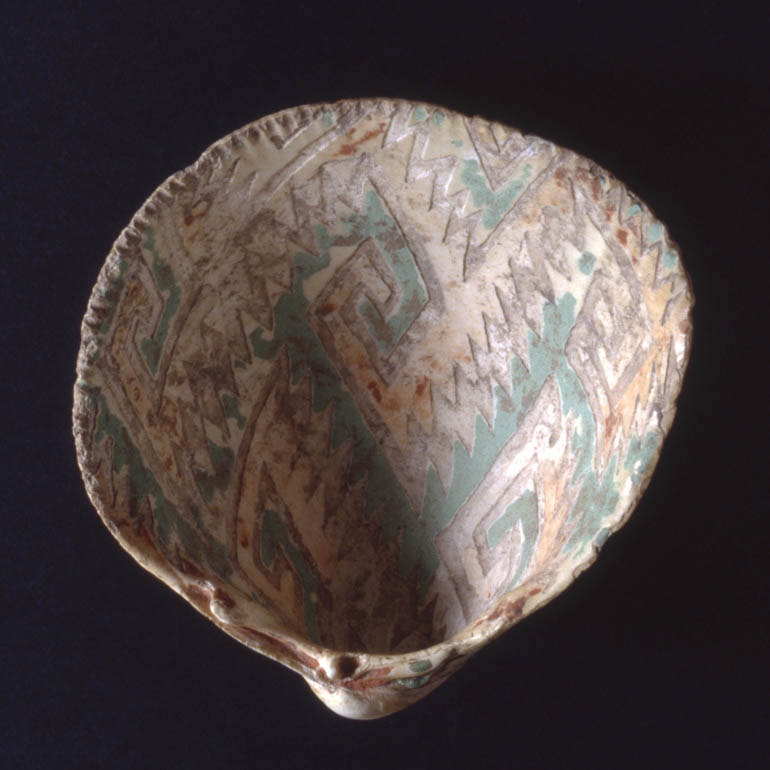
Shells with etched and painted animals and geometric designs. This etching technique, using cactus juice to eat away the surface, was employed in the Southwest 500 years before the technique was discovered by Europeans. - Concave inner surface of a shell with etched geometric design; the design elements are emphasized with the addition of turquoise and red pigment. Among the Hohokam pieces, this is among the most striking and beautiful. Width: 4.72 inches. ASM.
ASM = Arizona State Museum, University of Arizona, Tucson (Arizona)
  • Keywords:
    North America USA Arizona shell Pueblos Hohokam

Description

  • Foto Number: PUE-107C

Shells with etched and painted animals and geometric designs. This etching technique, using cactus juice to eat away the surface, was employed in the Southwest 500 years before the technique was discovered by Europeans. - Concave inner surface of a shell with etched geometric design; the design elements are emphasized with the addition of turquoise and red pigment. Among the Hohokam pieces, this is among the most striking and beautiful. Width: 4.72 inches. ASM.
ASM = Arizona State Museum, University of Arizona, Tucson (Arizona)

  • Keywords:
    North America USA Arizona shell Pueblos Hohokam

Website © 2026 pb + StratLabs
Copyright © Estate of Maximilien Bruggmann for all photos. Any use for commercial purposes prohibited.
flag flag flag flag