logo
  • Home
  • His life ...
    • Biography
    • Curriculum Vitae
    • Book: “Maximilien au Désert” NEW !
  • His work ...
    • Books
    • Expos
    • Painting
    • Embossings
    • New Year's wishesNEW !
    • Online ExhibitionsNEW !
    • Slideshows
  • Media ...
    • Documentation
    • Videos
    • Contact
  • Photo Gallery ...
    • All Photos
    • -
    • Sahara Rock Art completed
    • Tuareg
    • Pueblos
    • Northwest Indians
    • Peru
    • The culture of the Incas
    • Pre-Inca cultures
    • The Andes
    • Argentina
    • Gauchos
    • Central America
    • Sahara 1962-1975
    • Sahel
    • Sahara : Tassili - Tadrart 1993
    • From the Ténéré to the Aïr Mountains
    • In the dunes of Erg Izane
    • Across the Tamgak Mountains
    • From Adrar Bous into the Tamgak Mountains
    • With the Tuareg on the edge of the Tamgak Mountains
    • Building a Tataram: Documentation
    • The Spice Route – Spices NEW !
    • The Spice Route – Java and Sulawesi NEW !
    • The Spice Route – Moluccas NEW !
    • The Spice Route – Malaysia, Singapore and Sri Lanka NEW !
    • The Spice Route – India : Kerala, Goa and Mumbai NEW !
    • The Spice Route – India: Rajasthan NEW !
    • The Spice Route – Africa – Europe NEW !
  • Comments
    flag flag flag flag    

Description

  • Foto Number: ZAM-287

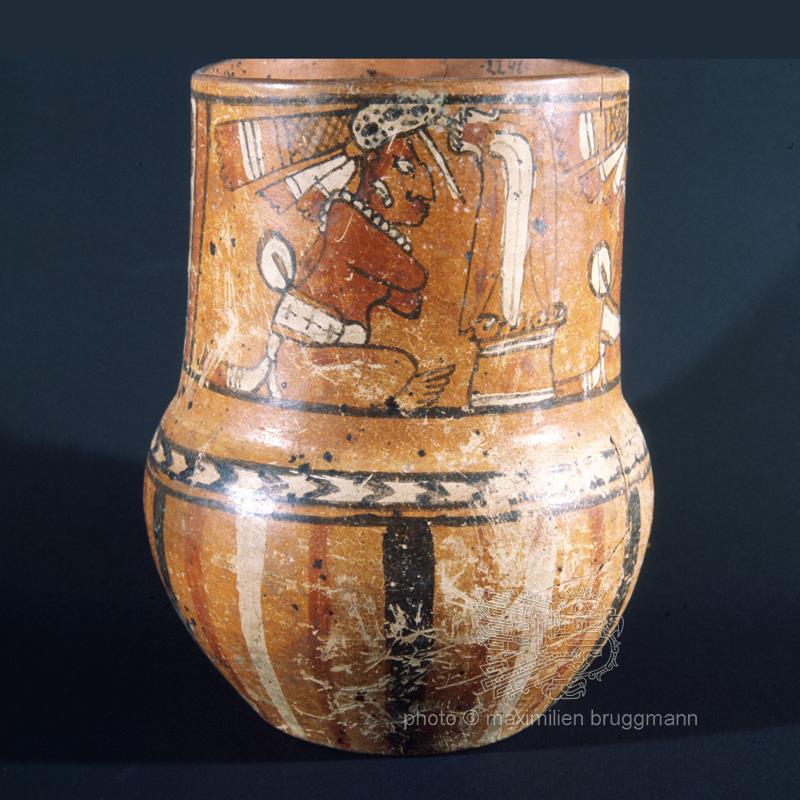
Polychrome terracotta vase from the Late Classic Maya period (Chama style) probably representing a priest wearing an impressive headdress made of rainforest bird feathers. This example is 21 cm high; the diameter of the opening is 13 cm (Museo Nacional de Arqueología y Etnología de Guatemala). Maya ceramics, of which a great number of samples have been collected, went through four stages of evolution, from the simplest and most utilitarian forms to more and more complicated, even baroque, ritual vessels and anthropomorphic pieces representing clergy or nobility. Other clay pieces are in the form of mythological animals. The study of these ceramics and their ornamentation has enabled specialists to supplement the information obtained from excavations carried out in the different regions occupied by the Maya throughout the pre-Columbian period. - 1977
  • Keywords:
    Central America Guatemala Maya ceramics vase Archaeology museum Museo Nacional de Arqueología y Etnología, GTM

Description

  • Foto Number: ZAM-287

Polychrome terracotta vase from the Late Classic Maya period (Chama style) probably representing a priest wearing an impressive headdress made of rainforest bird feathers. This example is 21 cm high; the diameter of the opening is 13 cm (Museo Nacional de Arqueología y Etnología de Guatemala). Maya ceramics, of which a great number of samples have been collected, went through four stages of evolution, from the simplest and most utilitarian forms to more and more complicated, even baroque, ritual vessels and anthropomorphic pieces representing clergy or nobility. Other clay pieces are in the form of mythological animals. The study of these ceramics and their ornamentation has enabled specialists to supplement the information obtained from excavations carried out in the different regions occupied by the Maya throughout the pre-Columbian period. - 1977

  • Keywords:
    Central America Guatemala Maya ceramics vase Archaeology museum Museo Nacional de Arqueología y Etnología, GTM

Website © 2026 pb + StratLabs
Copyright © Estate of Maximilien Bruggmann for all photos. Any use for commercial purposes prohibited.
flag flag flag flag